April 29, 2011

art secret 7 - painting pussywillows

These photos are a wonderful example of the elegance of the branches...

study how they curve and dance through the air and


look at all the different colors in the stems, buds and flowers.


Do you want to sketch out your drawing or just start painting? I used burnt sienna, sap green, dioxine violet and burnt umber in my stems and paint wet on dry.


Either way start with the branches and get your light and dark areas painted in.


Now you are ready to add the flowers. I always suggest that you add the jackets to the branch first and then paint in the flowers. And here is the Art Secret! Before you paint, wet the area where you want to add a flower starting near the stem and then add a drop of-you guessed it-Rose Dore and let the water do the work for you. While it's wet add your choice of another color to the flower and let the water pull the color over the rose dore and mix. The next Art Secret for the flower is to make sure that the color does not go to the edge, that way you  create a light and fluffy look around the flower. Now that you know, go have fun.


April 6, 2011

art secret 6 - Raoul Dufy

Raoul Dufy (1877-1953) was a French Fauvist painter who explored joy and optimism in his very colorful work. 
For more about him click here...  Raoul Dufy

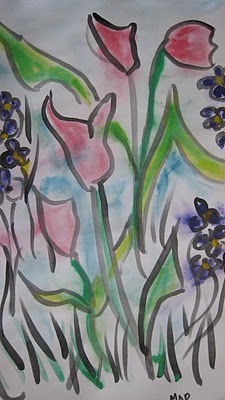
Below is a Raoul Dufy inspired project we did while 
working from an unusual orchid:
This orchid displays a very rare blue color.


Step One: first we did a very loose sketch using dark, watered down acrylic. 
                                                          

Step  two: After the acrylic was dry we added very loose, watery color with watercolor. You can add acrylic, too.

These are two paintings done in this style.
Doing studies in this manner is GREAT for getting the creative juices flowing. It's fun and fast.


December 14, 2010

art secret 5 - easy pine branches with watercolor

If you layer up three different shade of green starting with the lightest value...


you will end up with a very nice feathery, full pine branch. * Art secret...holding your brush perpendicular to the paper, use your wrist to flick the very tip of your brush to create the pine needles. Try it, it's fun.


Add a pine cone and some berries or...


if you want more atmosphere...
1. Start off with a background of a light blue wash and then add your branches and pine needles and maybe some snow. Personalize it the way that you want to.

October 21, 2010

art secret 4 - yellow and red don't make orange...

Well okay they do BUT...they also make light orange, yellow-orange, red-orange, violet-orange and you get the idea. Here's a sample.


And, of course, if you add the complementary color of blue to orange, you get a beautiful earthy color perfect for casting shadows. Depending on how much of each you add, you can adjust the  earthiness.

September 30, 2010

art secret 3 - red and blue don't make purple...

They don't?? Actually sometimes they do, but versions of those red and blue hues often make so much more like: maroon, blue-violet, red-violet, dark violet, light violet, pink, rose and so on. You can control your color and be a better painter if you mix your colors together to create a color instead of using a "tube" color. And if you add the complementary color you will create some beautiful muted, earth tones that a will defy description. Check out some of the color mixing that my students did. We had so much fun doing this.

acrylic

watercolor


acrylic


August 16, 2010

art secret 2 - new gamboge (yellow)

New gamboge is another Magic Color. Find it at Dick Blick.


New Gamboge is also a color that plays well with others and will add an amazing glow to your watercolor when used as an underpainting. It is a clean, clear yellow that won't muddy and has no green overtones. It's also a great color mixed or used on its own. Try it in a still life or sunset, you'll love it. Look how it gives the orange a delicious glow. Yummm.


Hint: It's an intense yellow-use it sparingly at first.


art secret 1 - rose dore


Did you know that a color called Rose Dore can give your watercolor paintings the life and luminosity that you're looking for? Use it as your underpainting color and watch what happens. It plays well with other colors and never gets muddy. It's a little pricey but well worth it. 


Hint: Rose Dore works best when you use it very lightly. You can find this at Dick Blick.


First I coated the entire paper with a light wash of Rose Dore. After it was dry I washed the sky area and added a rich pigment of Pthalo Blue. Notice how you can't see the Rose Dore but the sky has a lovely luminosity. When the painting was finished I went back in and added a richer Rose Dore to the tree trunks and along the horizon line to give life to the whole painting.